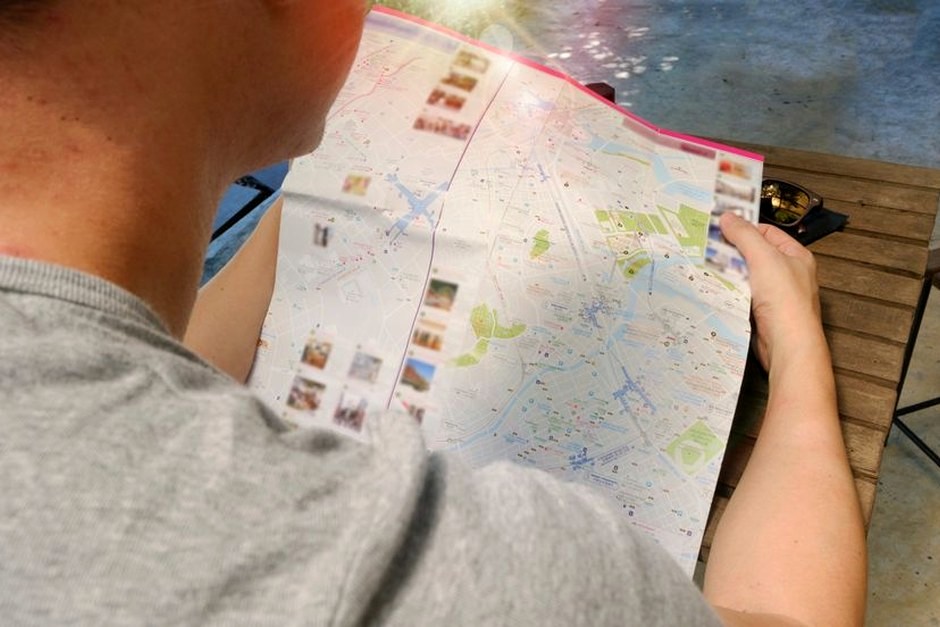
Most trips now produce hundreds of photographs and almost no physical trace. A paper map is an exception. It gets folded badly, marked with circles, softened at the corners and occasionally stained by coffee or rain. By the end of a journey, it has become a record of use rather than simply a guide.
That is why old maps are worth keeping even when the navigation information is no longer needed.
The map remembers decisions
A photograph records what you looked at. A marked map often records why you went there. A line drawn between two neighborhoods, a star beside a bakery, or a note about a viewpoint brings back the decisions that shaped the day.
Those small marks also preserve scale. Months later, it is easy to forget whether two places were a short walk apart or required a long train ride. The map restores the geography around the memory.
Keep only the pieces with a story
There is no need to save every brochure from a trip. One folded map, a transit card, a museum ticket or a handwritten restaurant note is enough. Choose objects that were actually used rather than collecting paper simply because it was available.
A simple envelope labeled with the place and year works better than an elaborate scrapbook if scrapbooking is not already a hobby. The point is to make the keepsake easy to keep and easy to revisit.
Add one sentence before you put it away
Write a single line on the back or on a small card: “We changed the route because of rain,” “Best bench was above the harbor,” or “Walked this street twice because we missed the turning.” A short note gives future context without turning the exercise into a travel diary.
Over time, a box of these small paper records becomes an unusually tactile archive. The objects are cheap and imperfect, but that is part of their appeal. They carry folds, handwriting and wear that cannot be reproduced later.
Digital photographs are still the richer visual record. Paper maps do something different. They preserve movement, choices and the practical shape of a day. For a keepsake that takes almost no effort, that is a surprisingly large amount of memory to hold.